Tailored Desktop Applications
Operations Workbench
A workflow tool built around the idea that repeated operational work should be modeled in software directly, not patched together through spreadsheets and process memory.
The project exists to make one point clearly: once repeated operational work starts depending on scattered spreadsheets, undocumented handoffs, and operator memory, the problem is no longer just inconvenience. It is a software design problem, and a dedicated interface only becomes useful when it is backed by workflow logic that can carry the process forward.
The solution is to give the workflow its own application model. Instead of treating the interface as the product and leaving the real process outside it, the system is designed around repeatable task actions, explicit states, validation boundaries, and a structure that keeps the workflow logic separate from presentation. That makes the interface easier to evolve and gives future features a stable place to attach.
Challenge and context
The case study starts with the operational pressure or software gap that made this work worth building.
A lot of operational work starts out manageable in spreadsheets, notes, and informal handoffs, then quietly becomes harder to trust. Status gets tracked in different places, validation depends on memory, and the workflow itself never really becomes part of the software. Once that happens, the team is not just missing polish; it is missing a clear model of the work.
Why this mattered
The project exists to make one point clearly: once repeated operational work starts depending on scattered spreadsheets, undocumented handoffs, and operator memory, the problem is no longer just inconvenience. It is a software design problem, and a dedicated interface only becomes useful when it is backed by workflow logic that can carry the process forward.
Solution delivered
This summary explains the shape of the solution Strucate put forward in response to the challenge.
The solution is to give the workflow its own application model. Instead of treating the interface as the product and leaving the real process outside it, the system is designed around repeatable task actions, explicit states, validation boundaries, and a structure that keeps the workflow logic separate from presentation. That makes the interface easier to evolve and gives future features a stable place to attach.
Solution summary
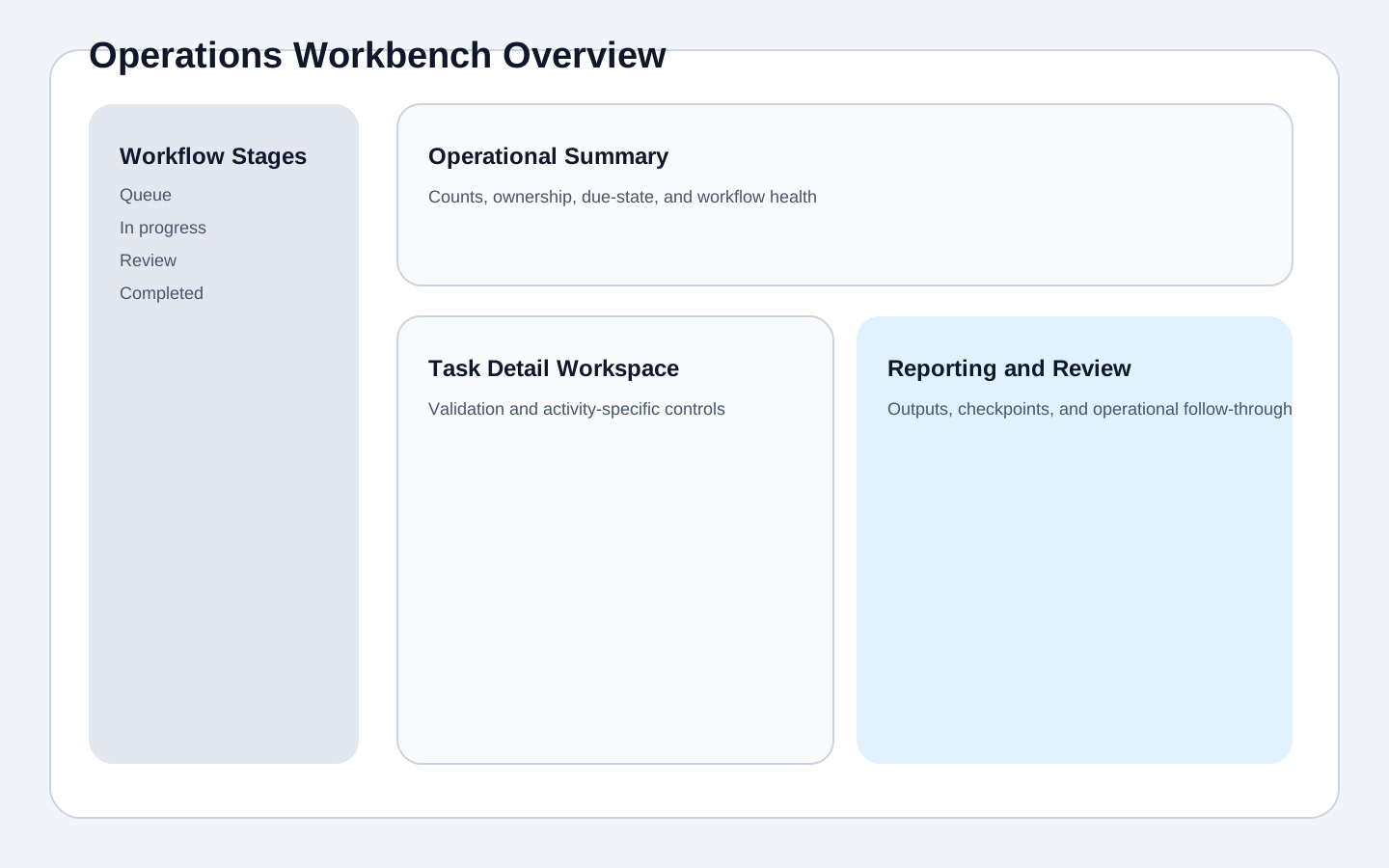
Operations Workbench is a desktop-style application for recurring operational tasks that are too important to leave scattered across ad hoc tools. The project focuses on giving operators a dedicated interface, making workflow state explicit, and keeping the application logic clear enough that the system can grow without collapsing into a collection of special cases.
Delivery scope
This work is framed as company delivery proof, so the scope needs to be clear before the deeper technical sections.
Strucate treated this case study as proof of delivery around a specific software need: shaping the application model, defining the workflow or system boundary, and carrying the implementation far enough that the structure becomes credible as a maintainable foundation.
Engagement focus
The most important decision was to treat repeated operational work as an application problem, not a dashboard problem. Once that was clear, the right shape was a dedicated interface backed by explicit workflow logic rather than a loose collection of screens and status badges.
What the delivery needed to achieve
The goals describe what this engagement or software direction needed to accomplish to count as useful work.
- Replace fragmented spreadsheet-and-handoff work with a dedicated interface that matches the operator's actual job
- Keep the workflow rules explicit so the software can explain why a task is in a given state instead of relying on operator memory
- Make later additions like validation, reporting, and task-state history possible without rebuilding the whole application shape
Architecture and implementation reasoning
Technical depth still matters, but it is framed here as the reasoning behind the delivered system and the company capability it demonstrates.
The system is structured as three clear layers: a dedicated operator interface for the day-to-day task flow, an application layer that owns state transitions and validation rules, and a local data layer that keeps records inspectable instead of hidden behind improvised process. That separation matters because the interface should be able to change without rewriting the workflow rules, and future reporting or automation should be able to grow without turning the UI into the source of truth.
Key technical decisions
- The project is built around explicit workflow stages so the software can describe task movement and validation as system behavior rather than as UI decoration
- The first scope stays local-first and desktop-oriented because the immediate value is reliable operator handling, not collaboration features or hosted infrastructure
- Interface behavior is separated from workflow logic early so future extensions can target the application layer instead of accumulating inside components
Tradeoffs accepted
- Keeping the first scope local-first and operator-focused makes the workflow easier to reason about, but it deliberately postpones synchronization, permissions, and multi-user coordination concerns
- Modeling the workflow explicitly costs more upfront design effort than a faster screen-first prototype, but it avoids pushing business rules into components that will be harder to unwind later
- Using a dedicated interface narrows the early scope, but that tradeoff is what lets the system reflect the work clearly instead of becoming a general-purpose admin surface
Delivery challenges
These points show where the work required extra care to keep the system coherent, explainable, and implementation-ready.
- Choosing enough workflow detail to make the tool believable without pretending the whole operational domain was already fully modeled
- Keeping the interface and the workflow rules separate so the project reads like software with internal structure rather than a screen mockup with labels
Outcomes and operational value
Where direct client metrics are unavailable, the outcomes stay company-safe and focus on the operational or engineering value established by the work.
- A clearer delivery proof example for internal software that earns its value by reducing ambiguity in repeated work
- A project structure that already makes room for future reporting, validation, and task history without changing the core interaction model
- A stronger demonstration of how operator-facing behavior can stay separate from the workflow rules that need to remain stable behind it
Future improvements
These next steps show how the current implementation could be extended without changing the core delivery direction.
- Add concrete workflow states, validation paths, and reporting views so the project shows how repeated work moves through the system
- Introduce annotated task examples that make the transition from operator action to workflow rule easier to follow
- Expand the local data model so future reporting and audit-style views can grow without changing the task-handling layer
Future direction
This is the next company-safe direction for deepening the delivery proof if the case study or system is expanded later.
The next step is not a visual redesign. It is to deepen the operational model by making the workflow states, validation rules, exceptions, and reporting outputs concrete enough that the benefits of the structure become visible in real task movement.
Continue through the work
These additional case studies help show the range of delivery proof across the current company work profile.
Case study snapshot
- Category
- Tailored Desktop Applications
- Delivery focus
- The most important decision was to treat repeated operational work as an application problem, not a dashboard problem. Once that was clear, the right shape was a dedicated interface backed by explicit workflow logic rather than a loose collection of screens and status badges.
- Status
- in-progress
- Stack
- TypeScript · Next.js · Tailwind CSS · Structured Content
Project Links
Tags
How to read this case study
Technical depth stays in the case study, but the reading order now starts with challenge, solution, scope, and outcomes before moving into deeper implementation reasoning.
Use the opening sections to understand the delivery context first, then move into the architecture, technical decisions, and implementation tradeoffs that shaped the work.